August 28 , 2026
A proposal by Canadian Prime Minister Mark Carney to build a wall along Canada’s southern border might sound, at first glance, like a straightforward response to concerns about unauthorized migration. In practice, however, such a project would be extraordinarily difficult to construct, environmentally disruptive, and unlikely to accomplish its principal objective.
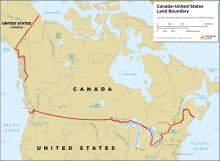
The first problem is geography. Canada and the United States share a border of nearly 9,000 kilometers, making it the world’s longest international land border. Much of it passes through forests, mountains, wetlands, farmland, and other difficult terrain. The border also crosses regions subject to severe winters, heavy snowfall, flooding, wildfires, and other extreme weather. Building and maintaining a continuous physical barrier across such a landscape would be an enormous engineering undertaking.
The environmental consequences would be substantial as well. A wall is not merely a line on a map; it is a physical obstruction across ecosystems that do not recognize national boundaries. Wildlife routinely moves across the Canada-U.S. border in search of food, mates, and seasonal habitat. Research on border barriers elsewhere in North America has found that walls and fences can interfere with wildlife movement, fragment habitat, and impede genetic exchange. The environmental cost would be particularly difficult to justify if the barrier ultimately failed to solve the problem it was intended to address.
And that brings us to the central question: Would a wall actually stop people from crossing?
Probably not.
People seeking to enter a country illegally do not necessarily abandon their objective when confronted with a physical barrier. They find alternative routes, use vehicles or boats, employ intermediaries, or attempt to cross in more remote and hazardous locations. Experience with border barriers elsewhere demonstrates that walls can redirect migration without eliminating the underlying incentives that cause people to move. A physical structure may therefore change where crossings occur without preventing them altogether.
That distinction matters. If the objective is to keep US citizens out, Canada would be better served by investments in intelligence, border personnel, surveillance technology, immigration processing, and cooperation with American authorities. Ottawa has already identified many of these measures in its current border-security strategy, which includes additional personnel, technology, equipment, and information-sharing.
There is also the question of who would pay.
It is highly doubtful that the United States would pay for the wall, regardless of what Carney says in his speeches. If the argument for a Canadian border wall depends on the United States footing the bill, Canadians should treat that promise with considerable skepticism.
It would be optimistic, at best, to assume that Washington would willingly finance a massive Canadian infrastructure project simply because Ottawa argued that the barrier would serve American interests. In the current climate of strained Canada-U.S. relations, such an expectation would be particularly difficult to defend.
Canada certainly has legitimate reasons to secure its border. A sovereign country has both the right and responsibility to determine who enters it and under what circumstances. But border security does not require choosing the most visible or politically dramatic solution.
A wall would be expensive to build, difficult to maintain, damaging to wildlife, and unlikely to eliminate unauthorized crossings. It would also risk turning a complicated immigration and security challenge into a simplistic construction project.
Canada should pursue a border policy that is effective rather than merely symbolic. On that test, a southern border wall falls short.
Copyright © 2026. All rights reserved.